A.3 FLTR MACHINES
APPENDIX A: MACHINES > A.3 FLTR MACHINES · PDF 第 101–106 · OS 1.12
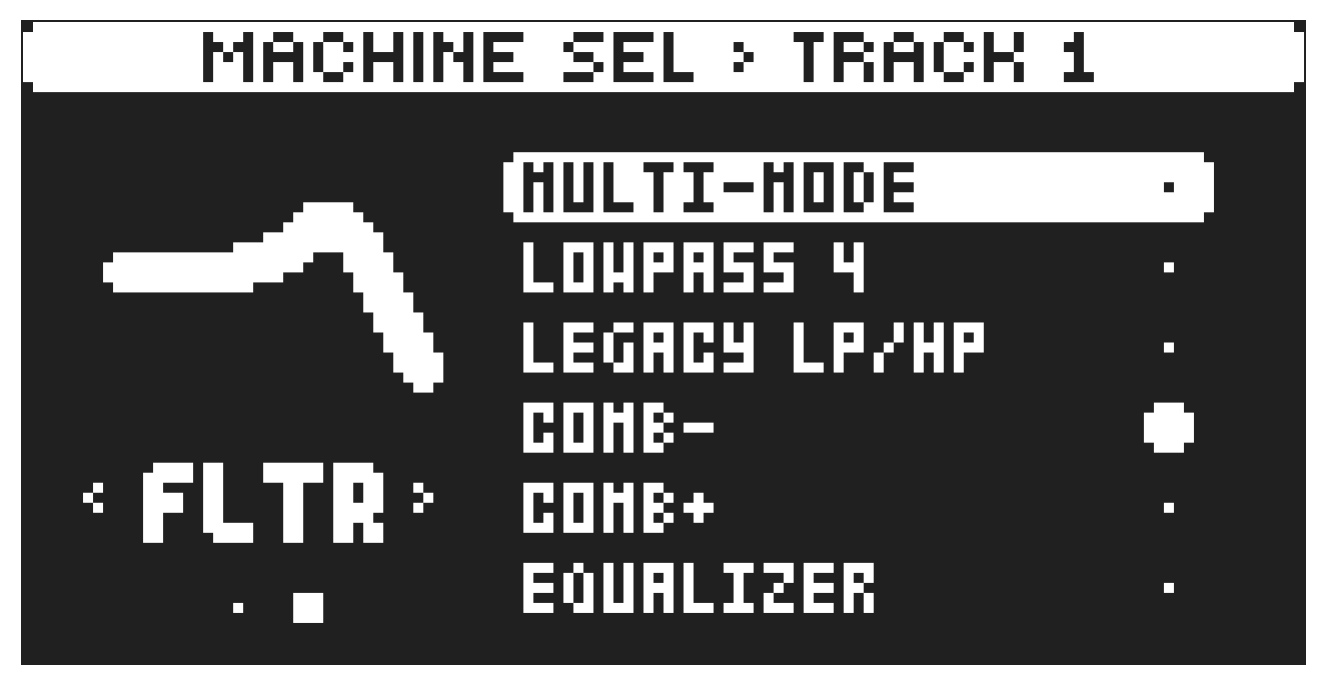
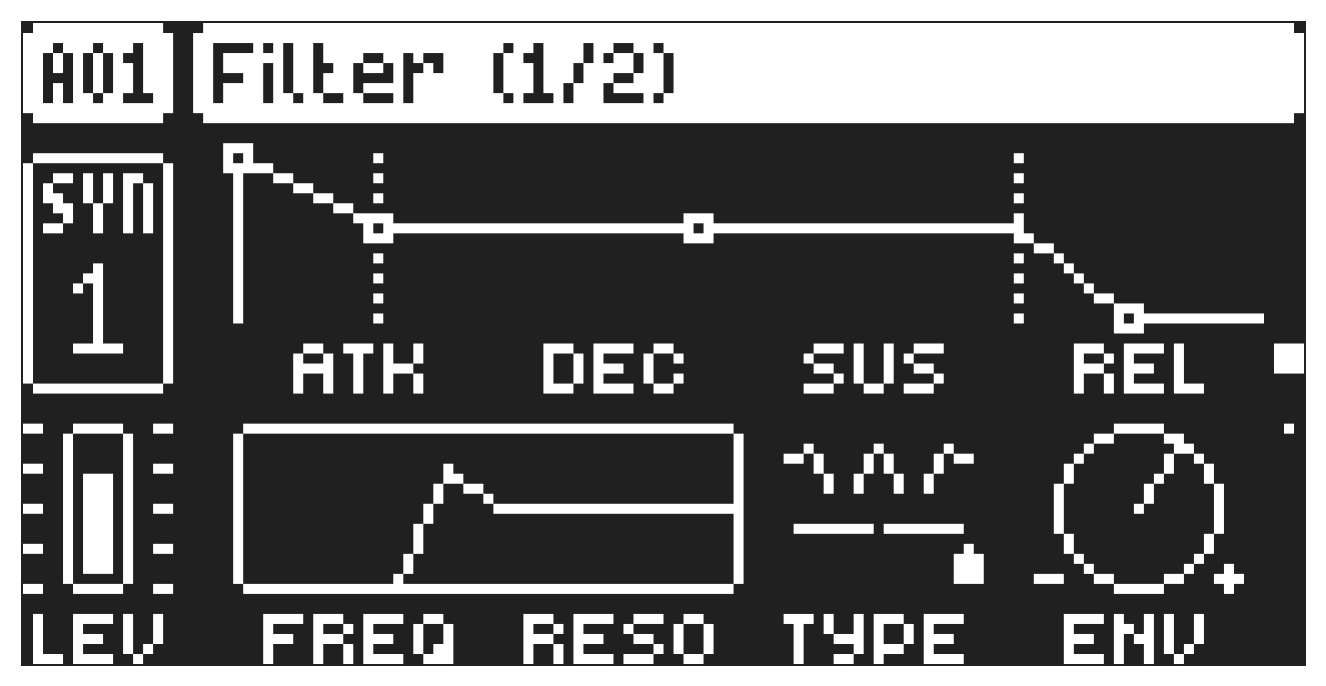
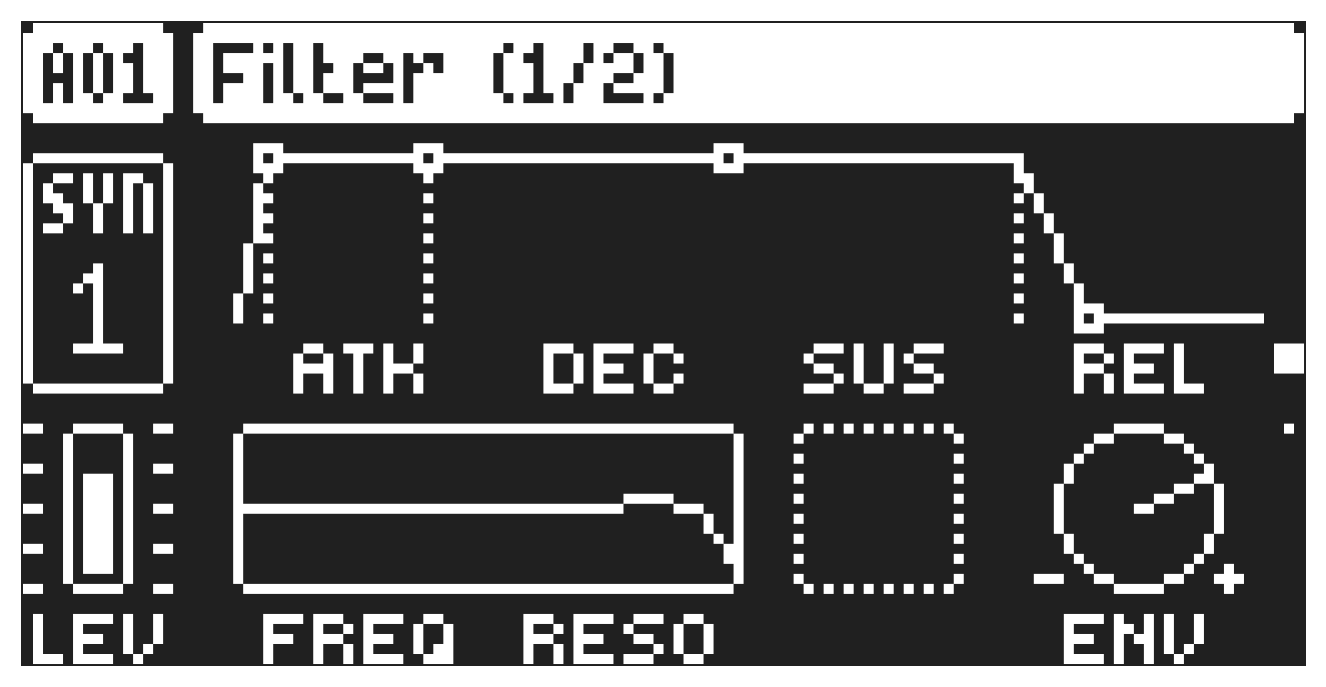
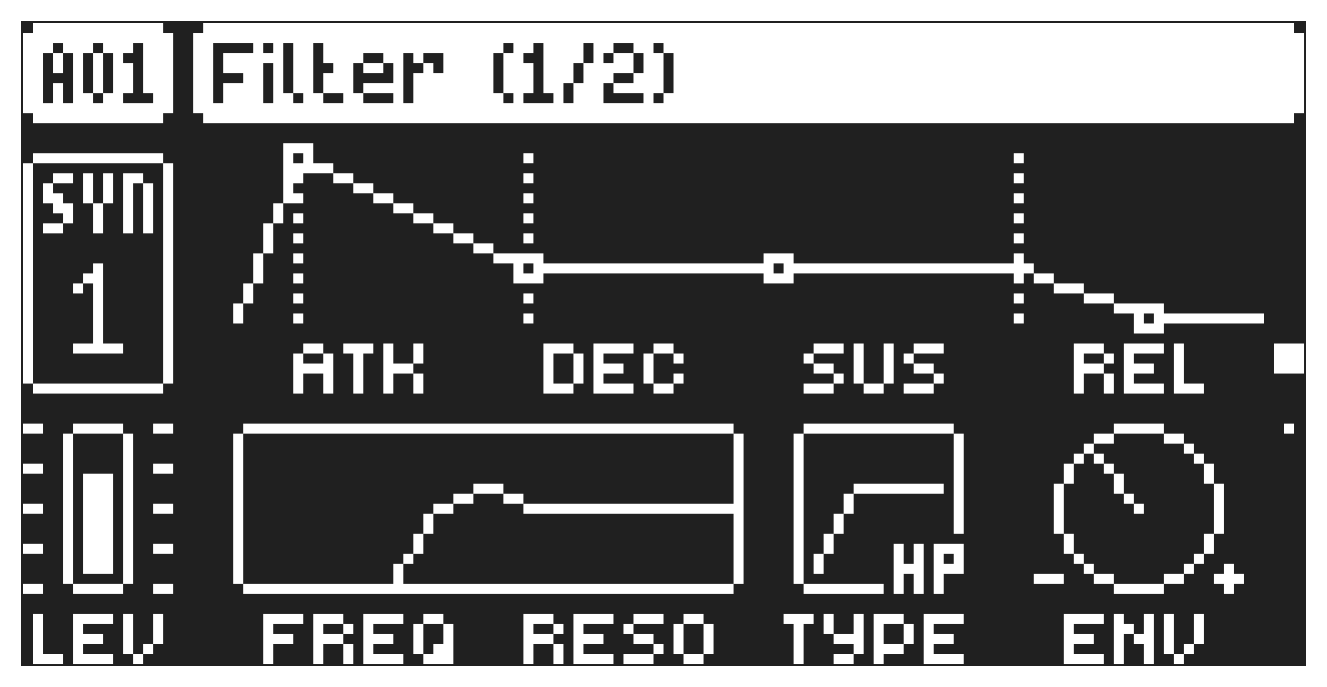
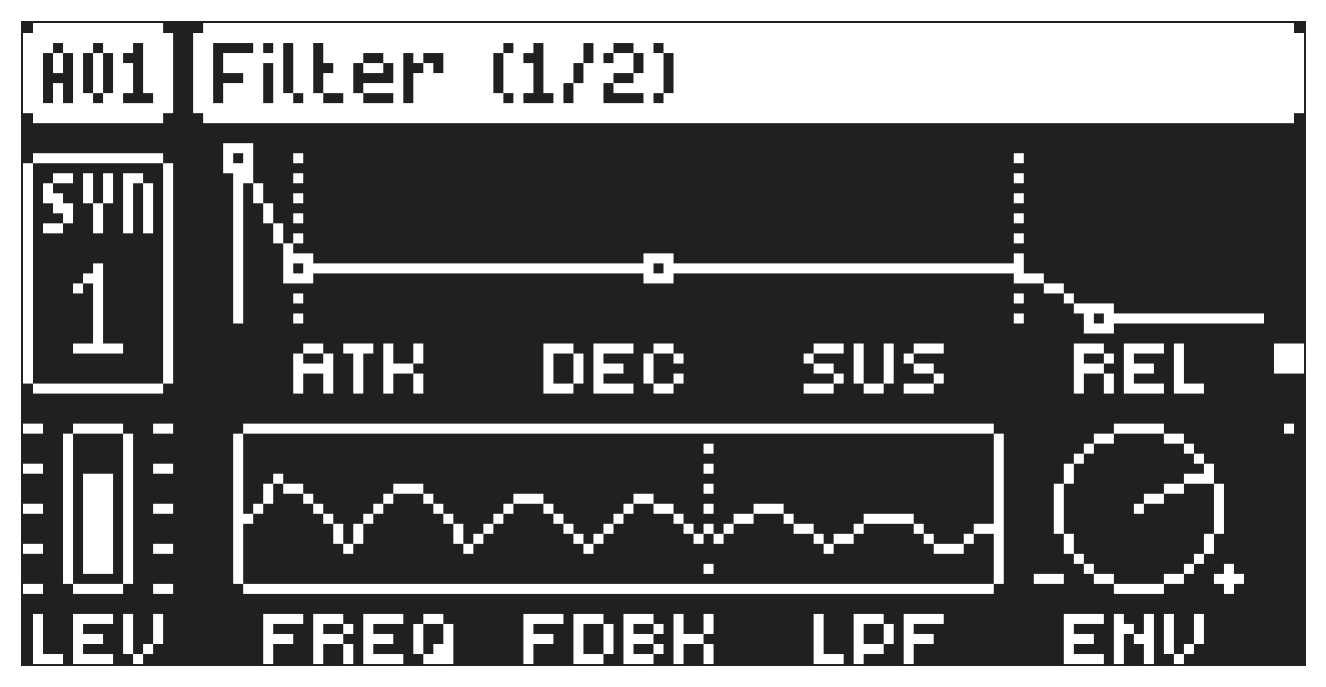
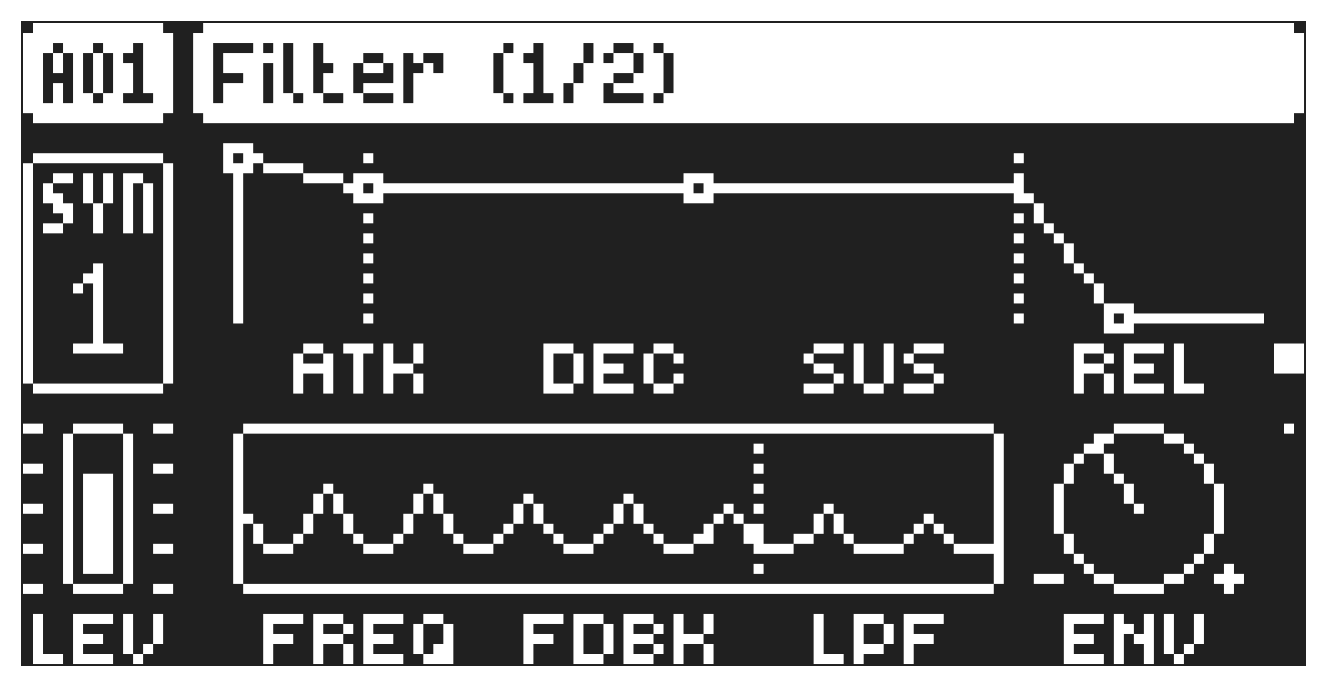
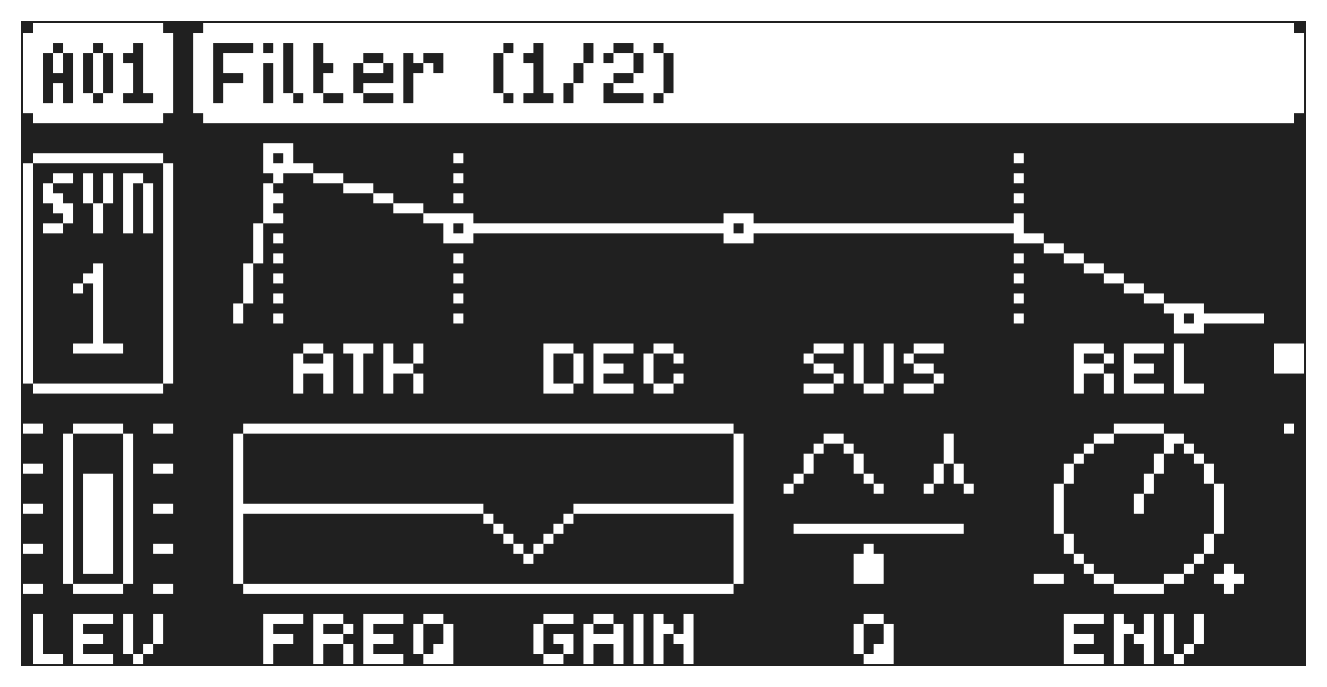
The FLTR machines are a collection of different filters and EQ.
A.3.1 MULTI-MODE
This filter lets you morph from a Lowpass to Bandpass to Highpass filter ATK
Attack Time sets the length of the attack phase of the filter envelope.
DEC
Decay Time sets the length of the decay phase of the filter envelope.
SUS
Sustain Level sets the sustain level of the filter envelope.
REL
Release Time sets the length of the release phase of the filter envelope.
FREQ
Frequency sets the cutoff frequency of the multi-mode filter and the center frequency of the EQ.
RESO
Resonance sets the resonance behavior of the filter. Resonance introduces a peak in the spectrum at the cutoff frequency. Gain sets the amount of boost/cut around the center frequency of the EQ.
TYPE
Type morphs the multimode filter from Lowpass to Bandpass to Highpass ENV
Env. Depth sets the amount of cutoff frequency modulation from the filter envelope. The knob is bipolar, both negative and positive modulation depths are available.
TIME
AMPLITUDE
Note On
Attack Decay Sustain Note Off
Release Env.
Delay
A.3.2 LOWPASS 4
This is a 4-pole low-pass filter with a 24 dB/octave slope.
ATK
Attack Time sets the length of the attack phase of the filter envelope.
DEC
Decay Time sets the length of the decay phase of the filter envelope.
SUS
Sustain Level sets the sustain level of the filter envelope.
REL
Release Time sets the length of the release phase of the filter envelope.
FREQ
Frequency sets the cutoff frequency of the filter.
RESO
Resonance sets the resonance behavior of the filter. Resonance introduces a peak in the spectrum at the cutoff frequency.
ENV
Env. Depth sets the amount of cutoff frequency modulation from the filter envelope. The knob is bipolar, both negative and positive modulation depths are available.
A.3.3 LEGACY LP/HP
The legacy filter is inspired by the filter from Digitone I and is a filter that is switchable between Lowpass and Highpass.
ATK
Attack Time sets the length of the attack phase of the filter envelope.
DEC
Decay Time sets the length of the decay phase of the filter envelope.
SUS
Sustain Level sets the sustain level of the filter envelope.
REL
Release Time sets the length of the release phase of the filter envelope.
FREQ
Frequency sets the cutoff frequency of the filter.
RESO
Resonance sets the resonance of the filter. Resonance introduces a peak at the cutoff frequency.
TYPE
Filter Type lets you select between a Lowpass or Highpass filter, both a 2-pole, 12 dB/octave slope.
ENV
Env. Depth sets the amount of cutoff frequency modulation from the filter envelope. The knob is bipolar, both negative and positive modulation depths are available.
A.3.4 COMB-
The comb filter introduces metallic sounding, pitch tuned, resonant overtones. The comb-filter has negative feedback and produces a more hollow, tube-like sound.
ATK
Attack Time sets the length of the attack phase of the filter envelope.
DEC
Decay Time sets the length of the decay phase of the filter envelope.
SUS
Sustain Level sets the sustain level of the filter envelope.
REL
Release Time sets the length of the release phase of the filter envelope.
FREQ
Frequency sets the resonant frequencies of the comb filter.
FDBK
Feedback sets the gain of the feedback signal. Please beware that setting FDBK to a high value can create a very loud sound.
LPF
Low Pass Filter sets the cutoff frequency of the low pass filter in the feedback signal.
ENV
Env. Depth sets the amount of cutoff frequency modulation from the filter envelope. The knob is bipolar, both negative and positive modulation depths are available.
A.3.5 COMB+
The comb filter introduces metallic sounding, pitch tuned, resonant overtones. The comb+ filter has positive feedback and produces a more string-like sound.
ATK
Attack Time sets the length of the attack phase of the filter envelope.
DEC
Decay Time sets the length of the decay phase of the filter envelope.
SUS
Sustain Level sets the sustain level of the filter envelope.
REL
Release Time sets the length of the release phase of the filter envelope.
FREQ
Frequency sets the resonant frequencies of the comb filter.
FDBK
Feedback sets the gain of the feedback signal. Please beware that setting FDBK to a high value can create a very loud sound.
LPF
Low Pass Filter sets the cutoff frequency of the low pass filter in the feedback signal.
ENV
Env. Depth sets the amount of cutoff frequency modulation from the filter envelope. The knob is bipolar, both negative and positive modulation depths are available.
A.3.6 EQUALIZER
This machine is a parametric Equalizer.
ATK
Attack Time sets the length of the attack phase of the EQ envelope.
DEC
Decay Time sets the length of the decay phase of the EQ envelope.
SUS
Sustain Level sets the sustain level of the EQ envelope.
REL
Release Time sets the length of the release phase of the EQ envelope.
FREQ
Frequency sets the center frequency of the EQ.
GAIN
Gain sets the amount of boost/cut around the center frequency of the EQ.
Q
Q lets you select the bandwidth of the frequency range that the EQ affects. The higher the Q value, the narrower the bandwidth. A broad bandwidth boosts or cuts a larger band of frequencies than a narrow.
ENV
Env. Depth sets the amount of cutoff frequency modulation from the filter envelope. The knob is bipolar, both negative and positive modulation depths are available. The parametric EQ is used to boost desired frequencies or to remove unwanted frequencies of the sound.
The ATK, DEC, SUS, and REL parameters only affects the selected filter machine. Not the base-width filter on FLTR page 2.
APPENDIX B: THE FM TONE SYNTHESIS
APPENDIX B: THE FM TONE SYNTHESIS
B.1 OVERVIEW
The Digitone II's FM TONE machine is a four operator Frequency Modulation (FM) synth in the style of the classic 80s implementations. However, unlike the early FM synths, the Digitone II use its FM engine more like a complex tone generator than a complete synthesizer voice (although it does have this capability too). The Digitone II signal path is more similar to a typical subtractive synth than a classic FM voice.
FM
Overdrive Multimode Filter Base-width Filter Amp The idea of this design is to harness the raw, and often complex, soundscapes of FM synthesis and use a more well-known and approachable subtractive method for the overall sound shaping.
FM is a synthesis method where you add harmonics to the timbre by using modulation or layering to shape the sound. You add harmonics by modulating one oscillator’s pitch with the output of another oscillator. FM works similarly to how you would apply vibrato via an LFO. At slower modulation rates, it is simply vibrato, but when the modulating frequency reaches audio rate, the vibrato effects becomes a part of the sound and becomes a timbral effect instead.
B.2 OPERATORS
In FM synthesis the oscillators are called operators. Unlike the analog oscillator, the operator also contains an envelope and specific input and outputs, making it a sort of macro oscillator. FM combines two or more operators to generate a more harmonically rich output. An operator that is used to modulate another operator is called a modulator. The operator that generates, or carries, the resulting tone is called a carrier. Feedback is used to increase the sharpness of a sound and is usually only applied to modulators. The output of the operator is fed back into itself, resulting in added harmonics. For example, have a look at the Sounds B001 and B002 in the Digitone II to see how feedback is used to create a basic square and saw waveform. For more information, please see “A.2.1 FM TONE” on page 89.
Operator Waveform Envelope Feedback Modulation input Output Amplitude Wavelength (frequency) Output Modulator (ratio: 8)
Carrier (ratio: 1)