B.6 HARMONICS
APPENDIX B: THE FM TONE SYNTHESIS > B.6 HARMONICS · PDF 第 109–111 · OS 1.12
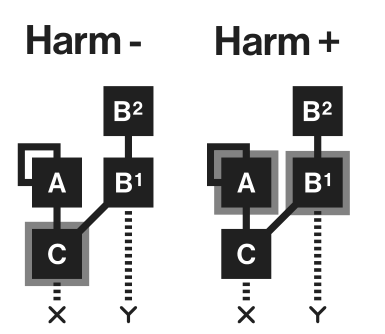
The default output from an operator is a sine wave, but you can use the HARM parameter to add upper partials to some of the operators’ sine waves to create more harmonically rich waveforms. The HARM parameter is bipolar. Negative parameter values change the harmonics of operator C, while positive parameter values change the harmonics of operators A and B1.
Harm -
Harm +
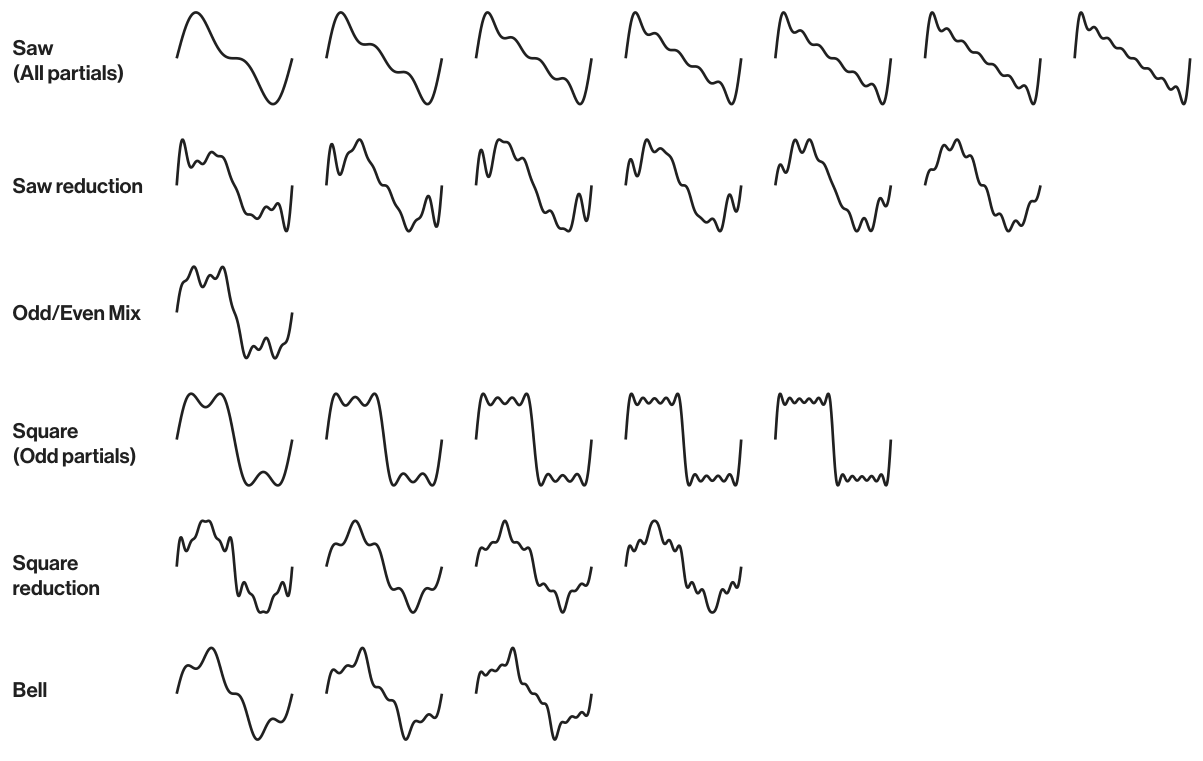
When changing harmonics, intermediate values interpolates between the current and the next harmonic. This interpolation works much like in wavetable synthesis, sweeping between the harmonics, smoothly transitioning from one timbre to another. For more information, please see “A.2.1 FM TONE” on page 89. The harmonic series for the operators looks like this:
Saw (All partials)
Saw reduction
Odd/Even Mix
Square (Odd partials)
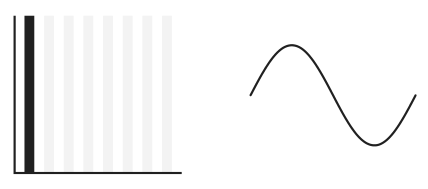
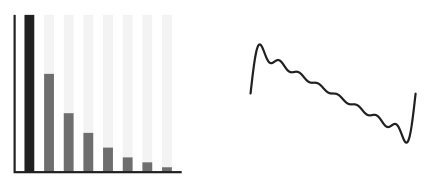
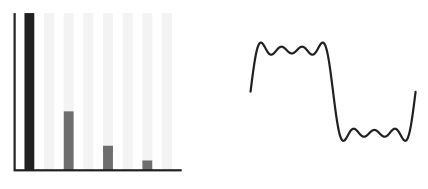
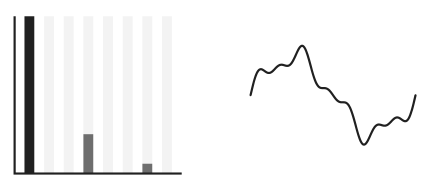
Square reduction Bell The Digitone II uses a form of additive synthesis to create the harmonic series for the HARM parameter. Additive synthesis is one of the oldest forms of electronic sound generation. It is a quite simple form of synthesis but still very powerful. The basic principle is to add multiple sine waves together to form complex timbres. Each sine wave is called a partial. By attenuating each partial, the timbre changes its harmonic content, resulting in different waveforms.
The first partial is always kept
at full volume, which keeps the
base octave intact.
Adding every partial in series
will replicate a sawtooth. Note
how the volume decreases for
each partial, creating a natural
falloff.
Adding every odd partial in
series will approximate a
square wave.
The additive method can be
used to make many different
timbres. This combination of
partials, for example, sounds
close to a bell tone.
B.7 SYN PAGE 1 PARAMETERS OVERVIEW
Here is a graphical overview of what part of the FM engine the parameters on the SYN1 pages affects. The affected part of the FM engine is highlighted with grey. For more information, please see “A.2.1 FM TONE” on page 89.
Detune Ratio A
Ratio B
Ratio C
Harm -
Harm +
Feedback Mix